


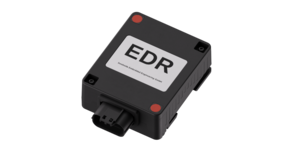
In the commercial vehicle industry, mandatory and standardized recording of safety-relevant vehicle data is becoming significantly more important. The basis is UN Regulation No. 169, in effect since June 2024, which enables harmonized crash analysis across Europe. As of early 2026, new vehicle types must be equipped with an Event Data Recorder (EDR); starting in 2029, this will apply to all new registrations. This brings a topic long familiar in the passenger-car world to buses, trucks, and specialty vehicles—with the goal of more accurate crash reconstructions and improved road safety. Personal data is explicitly excluded.
Technology That Meets Growing Requirements
How can manufacturers balance precision, technical complexity, and regulation? Swoboda’s new Event Data Recorder shows how to implement the requirements efficiently. The system integrates seamlessly into modern electrical architectures and adds functional value. High-accuracy sensors—including 3D acceleration, a high-g load sensor, and a 3D gyroscope—enable reliable reconstruction of even complex crash and emergency-braking sequences.
Integration and Tamper Protection Instead of a Standalone Solution
A key question for engineering teams is how much effort integration requires. The Swoboda EDR uses the J1939 communication standard via two CAN interfaces and supports relevant SAE protocols, ensuring compatibility in heterogeneous E/E architectures. The system operates in 12V and 24V environments, is rated for temperatures from −40 to +85 °C, and features a rugged IP54 enclosure—especially relevant for fleet operators.
As vehicle data becomes more important, expectations for cybersecurity continue to rise. ISO 21434 provides the guiding framework. The Swoboda EDR relies on multiple safeguarded firmware processes, hardware key management, and a tamper-evident housing seal—an increasingly important criterion in type approval.
Between Regulation and Value: More Than a Box-Checking Exercise
The EDR mandate creates a foundation for better diagnostics, transparent event documentation, and, over time, optimized fleet strategies. Large OEMs and smaller manufacturers alike can benefit.
Berthold Breitkopf, Division Manager: “We don’t just deliver a device—we deliver a system that fits smoothly into the type-approval process and provides a robust, future-proof solution.”
Key deadlines:
• January 7, 2026: mandatory for new vehicle types (M2, M3, N2, N3)
• January 7, 2029: mandatory for all new registrations in these classes
The minimum technical requirements are defined in UN Regulation No. 169—from trigger conditions and recording duration to crash survivability.
Technical Summary
The Swoboda EDR combines high-resolution 3D acceleration and gyroscope sensing to precisely capture driving events. A battery-backed real-time clock and 4 MB of flash memory ensure consistent timestamps and reliable data retention. Using the J1939 communication standard over two CAN interfaces, the system can be integrated flexibly and supports relevant SAE protocols. Designed for demanding vehicle use, the EDR is rated for −40 to +85 C; dual-protected firmware updates, hardware key management, and a tamper-evident housing seal meet the cybersecurity requirements of ISO 21434—helping streamline the type-approval process.
More info:
swoboda.com/en/products-solutions/product-overview/event-data-recorder-edr
Contact: berthold.breitkopf@swoboda.com